Monday, September 12, 2016

Is Hypergrace Biblical

Hypergrace, according to a mainstream Christian news magazine, is a dangerous and unbiblical teaching. By proclaiming the unconditional love of God and forgiveness for all, hypergrace preachers have taken grace too far. We have made grace unbalanced and radical.

Hypergrace, apparently, is unbiblical. It’s a modern invention based on a few scriptures taken out of context, and it does not reflect the whole counsel of God.

This claim – that hyper or extreme grace is unbiblical – is easy to test. All you need is a Bible.

Six pictures of God’s grace

In him we have redemption through his blood, the forgiveness of sins, in accordance with the riches of God’s grace. (Ephesians 1:7)

God is rich in grace, but how rich is he? The word for riches in this verse (ploutos) is the same word used to describe God’s wisdom and knowledge (Rom 11:33). God is as rich in grace as he is in wisdom. How wise is God? He is exceedingly wise! He is hyper-wise. As for one, so for the other. Limit God’s grace and you limit his wisdom.

And God raised us up with Christ and seated us with him in the heavenly realms in Christ Jesus, in order that in the coming ages he might show the incomparable riches of his grace, expressed in his kindness to us in Christ Jesus. (Ephesians 2:6-7)

Other translations refer to the “full wealth,” “extraordinary greatness,” and “immeasurable (limitless) riches” of God’s grace. According to this scripture his grace is surpassing and incomparable meaning “it can’t be compared with anything else” (NIrV). Whew. Calm down, Paul, you’re getting carried away! Your epistle is unbalanced and extreme.

And God is able to make all grace abound to you (2 Corinthians 9:8)

The word abound (perisseuō) means overflowing as in “more than you need.” It’s the same word used to describe the leftovers after Jesus fed the 5000. Excess food reveals excess grace. God gives you grace for your need and then he gives you extra grace that you don’t need until you are overflowing and spilling grace all over the place.

In other words, God is generous to the point of lavish wastefulness.

For if by the transgression of the one, death reigned through the one, much more those who receive the abundance of grace and of the gift of righteousness will reign in life through the One, Jesus Christ. (Romans 5:17)

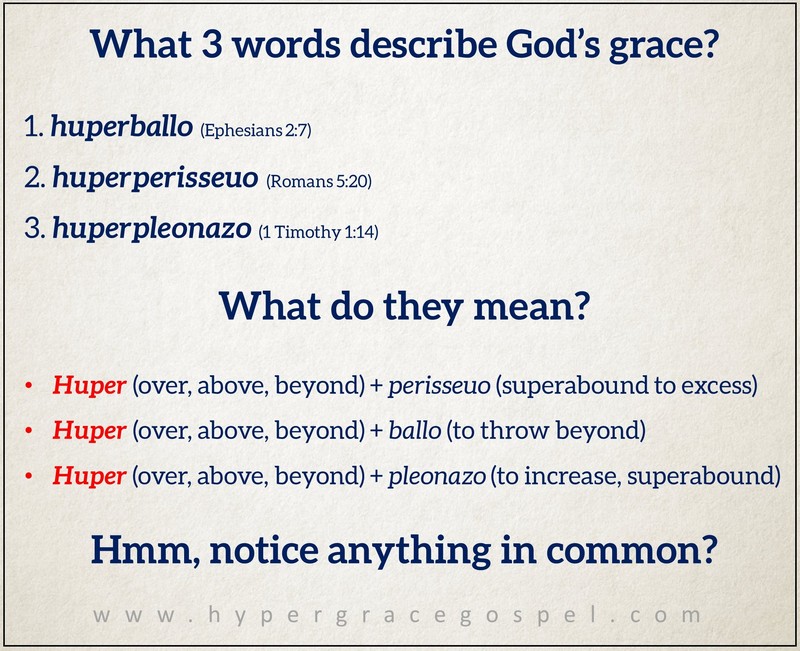
The abundance (perisseia) of grace doesn’t sound that impressive in English but it’s super-impressive in the original language. The word literally means super-abundant. What superman is to man, superabundant is to abundant. Read it literally and Paul is talking about the superabundance of God’s favor, which is an apt description of God’s exceeding, incomparable, and over-the-top grace.

The Law came in so that the transgression would increase; but where sin increased, grace abounded, all the more (Romans 5:20)

Paul uses the same word as before – the one that means super-abundant – and adds the prefix huper or hyper, which means over, above, and beyond (huperperisseuō). So if you think God’s grace is super-abundant to the point of superfluous excess, you are halfway there. And if you think it’s hyper-, you’re getting warmer but you’re still not quite there, for Paul literally preaches a hyper-super-grace!

The grace of our Lord was poured out on me abundantly (1 Timothy 1:14)

Yes, it’s the same old word in English but English is a woefully poor language for describing the extraordinary riches of God’s grace. Here we have another compound word, huper (over, above, and beyond) plus pleonazō, which means to increase or super-abound. As with his letter to the Romans, Paul literally describes God’s grace as hyper-super-abounding.

If we are to agree with the Bible, we should speak about grace the way the Bible does. We should use big, hyperbolic words and flowery phrases like this:

The grace (unmerited favor and blessing) of our Lord [actually] flowed out superabundantly and beyond measure for me… (1 Timothy 1:14, AMP)

Biblical grace is hyper

The apostle of grace demolishes the notion that hypergrace is an unbiblical or modern message, and we’ve only looked at six scriptures.

We have not examined the extreme grace of a God who loved us while we were sinners (Rom 5:8), who took the legal charges against us and nailed them to the cross (Col 2:14).

We have not considered the hypergrace significance of the cross and the empty tomb. On account of grace and at great personal cost, God tore up the books recording our sins (2 Cor 5:19).

Nor have we considered the testimony of a universe that is inexplicably expanding at an ever-increasing rate because it isn’t yet big enough to contain all the good things a hypergrace God has planned for us.

To suggest that God’s grace is less than hyper is unbiblical and blasphemous. It’s like saying God is good but he’s not that good, he’s wise but not that wise. Diminish grace and you diminish God.

Get your understanding of grace from Christian magazines, and you can be forgiven for thinking that hypergrace is bad, modern, and unbiblical. But read the Bible and you will see that hypergrace is a small word for describing an extraordinary reality: The One who sits upon the throne of grace is exceedingly rich in grace and he has poured out his measureless grace upon you!

Hypergrace preachers have not taken grace too far. On the contrary, we have not taken it far enough. We have not begun to scratch the surface of God’s goodness towards us.

hypergrace-biblical

Saturday, September 10, 2016

Bubbles Eventually Burst

By Anabel Gillham

For we have brought nothing into the world,
so we cannot take anything out of it either.

I Timothy 6:7

There’s nothing quite so helpless as a new born baby. He (she) is totally at the mercy of those who are caring for him. If his caretakers are loving, kind, compassionate, conscientious, tender, and gentle with him, his world turns at an acceptable, smooth, steady pace. Take any of those six things away from that infant, and his world starts rocking–he cries, and tries to get someone to love him, be kind to him, have compassion on him, wait on him patiently, hold him tenderly, and speak to him gently. He has nothing in his hands (which he has not as yet discovered can hold things) and he doesn’t have a single bag of “stuff” that he calls his own.

But wait. There is someone else very much like this new born babe: An old person who depends solely on those around him to care for him. In the same way, he needs a loving, kind, compassionate, industrious, tender, gentle person. And that pretty well sums up his needs. He doesn’t have anything in his hands either–not because he hasn’t discovered those hands, but because he has discovered that he can’t hold anything any longer. He may have two or three bags of “stuff” that he used to cling to tenaciously, but that “bag of stuff” has no meaning to him any longer and he probably can’t even remember what’s in the bag!

We shouldn’t be surprised at this turn of events. Timothy tells us that this is what to expect: We brought nothing into the world, so we cannot take anything out of it either.

There have been cultures that buried a person’s most precious possessions with him, believing that these would bring happiness to that person in the world to which he had moved when he left everything behind.

“Things” make life here on Planet Earth more comfortable, they give us security, they give us an identity, and they enhance life with more “fun.” There’s nothing wrong with that. It is just that I must realize that my “things” bring very temporary comfort, questionable security, a fragile identity, and the character of “fun” changes with every year added to our personal calendar.

I find it difficult at times to accept the truth about Anabel’s life as it is now. There are things I used to have a passion for–boating, skiing, hiking, hitting the ball back and forth at the tennis court (I hesitate to call what I did tennis), biking, outside activities of any kind, working up a good sweat out in the yard, painting all the rooms in the house and probably tackling the house, too! New Year’s Eve meant staying up all night with friends playing silly games and finishing the celebration with bacon and eggs at someone’s house for breakfast! My definition of “fun” at this time in my life is very limited–and don’t make any smart remarks–you’re heading in the same direction! It is New Year’s Eve and we’re usually with the crowd until at least 12:01! Tonight I am very content being here in my warm house, pajamas on, and ready to crawl into bed around ten or eleven and read for just a while. That can’t be! Not me! Anabel? Isn’t that unbelievable?

Oh well, I knew this would happen–Timothy (and hundreds of others in the same boat with me) told me this was inevitable!

But not to get alarmed. I have seen the futility of keeping watch over my bag of stuff; I have Someone taking care of me who is the epitome of kindness, tenderness, gentleness, is aware ofmy every need, and Who loves me dearly. I have an identity that cannot be taken away from me even if I’m in a comatose state in the nursing home, and I am going to be moving one of these days to a place that He has prepared just for me! Do you see why I can say–“Don’t fret! It’s okay! Everything is going to be all right!”

Thanks, Timothy, for the words of wisdom that you penned those years ago. As I live on this Planet Earth with all the other people, I’m finding your words to be totally true! And thank You, Lord, for loving me and taking such good care of me. I anticipate seeing what You have fixed up–just for me!

Thursday, September 8, 2016

Christ Died For ALL.

Christ Died For ALL.

What happened at the cross? The obvious thing that most people mention first is that Jesus put away the sins humanity had committed against God. But if that were all Jesus had done, we would still have a big problem. Sins were the symptom of a deeper problem—man’s utter confusion about God’s identity and about his own. That darkened understanding came from Adam. It is a darkened mind, doomed to produce sinful actions. What good would it do to deal with the fruit and leave the root intact? Our minds had to come alive to the truth of what Christ has done and who we are.

So Jesus also had to do a second thing at the cross.

Not only did the sins of Adam’s race need to be put away, but Adam’s race itself had to die. As long as the family of Adam continued to live, nothing else could happen other than sin. Embracing the identity of a sinner can produce nothing but sinful actions. Mankind didn’t simply need to stop sinning. We needed the source of sin to be put to death. Cleaning up a flooded room does no good if you don’t stop the leaking faucet.

So that is exactly what Jesus did. He took on Adamic humanity, drawing it into Himself on the cross so we would die with Him. Jesus wasn’t the only one who died on the cross that day. You died with Him!

The question is, who else was included—only believers, or does this act of Jesus on the cross include everybody?

The Bible answers this clearly. “The love of Christ controls us, having concluded this, that one died for all, therefore all died; and He died for all, so that they who live might no longer live for themselves, but for Him who died and rose again on their behalf” (2 Corinthians 5:14-15). For whom did Jesus die? Twice in this text, Paul wrote that He died for all.

Does all really mean everybody?

Some suggest that the word all doesn’t always mean everybody, and they are correct. The Bible sometimes uses the word in a generic sense. For example, the Bible says that all Judea went out to be baptized by John in the Jordan (Mark 1:5). Obviously, not everybody in Judea was baptized. The word there means, “all types of people.” It’s like saying, “Everybody eats at that restaurant.” We don’t literally mean everybody. We’re using the word in a general sense.

On the other hand, the word can also mean each and every person. The question is, did Jesus die for all types of people or for each and every person? I believe the latter to be the case. The Scripture says, “But we see Jesus, who was made a little lower than the angels for the suffering of death, crowned with glory and honor; that he by the grace of God should taste death for every man” (Hebrews 2:9 KJV). He didn’t just die for all kinds of people.

Jesus tasted death for every person.

Look again at the verse in 2 Corinthians 5. “One died for all.” Who is the One who died for all? That’s Jesus. Who are the all? That’s everybody.

Paul goes on to say, “Therefore all died.” Is it the same all? Of course it is. The verse clearly teaches that the same ones for whom Jesus died are the ones who died with Him. Jesus died for Adam’s race, and that same race (humanity) died with him.

What He accomplished on the cross is real regardless of whether we know it or believe it.

You and your decision didn’t cause your co-crucifixion with Christ. Jesus and His finished work accomplished that. Let’s not say we believe that everything is centered in the cross and then turn around and contend that the cross means nothing until we believe it. Let the credit rest where it belongs—on Jesus.

Does this then mean everybody is a Christian? No, it doesn’t.

A Christian is a believer in Jesus Christ. Rather, it means that the success of the finished work of Jesus Christ on the cross doesn’t depend on human beings casting a vote in His favor. When He cried out, “It is finished,” He meant it. There is nothing we need to do to deal with the problem of sin. Jesus has already done it. All need only to believe it and receive it so that our experience aligns with the eternal reality of His successful work on our behalf.

Our sins and our sinful nature were both crucified with Him that day.

We aren’t included in the crucifixion of Jesus at the moment we believe. “I have been crucified with Christ” regardless of whether I have faith in Him. My belief doesn’t make it real. Humanity’s co-crucifixion with Jesus on the cross is real whether we believe it or not. Watchman Nee wrote, “It is the inclusive death of the Lord which puts me in a position to identify myself, not that I identify myself in order to be included. It is God’s inclusion of me in Christ that matters.” Which, then, is the correct order?

Do we believe and then become included in His death, or we are included and then believe?

Nee rightly answers that we are not included because we believe. We believe because we are included, and that is what matters. Faith doesn’t make it happen. We died with Jesus, and the old Adamic nature was destroyed. It happened! We all died with Him—that’s a historical fact regardless of whether we have faith. Faith doesn’t manufacture anything. It simply sees what already exists and is real whether we see it or not. We all died with Jesus, and that is a fact.

- Steve McVey

Wednesday, September 7, 2016

Can a Christian Be Demon Possessed? No!

So if the Son sets you free, you will be free indeed. –John 8:36


1.       There is never a hint in Scripture that the solution to a believer's problem is demon  
          possession. The Epistles deal with a variety of practical problems from self-
          righteousness to unrighteousness, and nowhere is the casting out or denouncing
          of demons given as a solution.

2.       For the unbeliever the condition of internal demon possession is dealt with by
          casting out the demon. For the believer, the external works of the enemy  
          (temptation and false doctrine) are to be resisted and stood against.

3.         The Greek word for demonization (daimonizomai) is translated "to be possessed by a demon." In context, it is translated as one who has a demon dwelling in him. The word is only used in the Gospels. Those who believe in the possibility of demon possession of Christians often make the distinction between possession in the spirit of man, possession in the soul (mind, will, emotions), and possession of the body. However, Jesus makes it clear that casting out the demons is analogous to casting out the inhabitants of a house (Matthew 12: 28, 29, 43-45). I Corinthians 6:19 states that the body is the temple of the Holy Spirit, and Paul there speaks of the body, not the soul or spirit, for the body encompasses all. How, then, can it be said that the demon could be in the body of the believer but not in the spirit? The body is the Lord's. John tells us that "greater is He who is in you than he who is in the world" (I John 4:4). A demon cannot enter a believer and take over, for it is God's house the demon would be attempting to enter. Remember when the High Priest went with fear and trembling into the Holy of Holies? Are we to believe a demon can enter the Holy of Holies established in the believer?

4.         There are many passages that declare that Christ's victory over Satan is so complete that Satan cannot come back and take (possess) the believer (John 17:15; I John 5:18; II Thessalonians 3:3).

5.         The concept of worship, by its very nature, involves the giving of attention to the respected being. Many believers devote precious time focusing on the work of Satan, hence, in some type of convoluted manner, worshipping him. So much time is spent binding, rebuking, and casting out demons that could have been spent worshipping Jesus. People that constantly focus (worship) on the demonic have an oppressed look, which they take as a proof of the great battle they are in, though the battle has already been won by the only One worthy of the fight. They have the countenance they have earned from not setting their minds on the things above.

6.         "If only you had seen what I have seen!" This appeal to experience falls flat. Traveling as I do, I have seen things that I would not even pen. Though I saw them, neither Scripture nor the Holy Spirit testify to their likelihood; they merit only the trash bin. It must be recognized that Satan is a liar through and through.

7.         There is the problem of categorizing as demons the deeds of the flesh listed in Galatians 5. The flesh cannot be cast out but only denied by taking up the cross. I asked a question of a pastor who was casting demons out of believers: "You claim to be casting out by name attributes that Scripture identifies as the deeds of the flesh. That cannot be done. In six months what are you going to tell that eighteen-year-old boy when his hormones are surging and he is once again lusting? Will you tell him the demon of lust returned?” His answer surprised me: "No, then we will tell him to abide!" Obviously my next question was: “If abiding works, then why would it not work in the beginning?” If the desire is to confuse and oppress, tell a believer who is struggling in mind, will, or emotions that his problem is a demon.

8.         Finally, I remember when this teaching of demons plaguing the Church was introduced in the early seventies. Where are those same proponents today? If demons were the real problem with defeated Christians, then why are the same men not loudly proclaiming the message throughout the Church today? The world is getting worse. Have those men cast out all of the demons? No, the men are still around but have moved on to "new" spectacular methods, programs, and causes. Yet the old banner continues to be picked up by others.

Given the biblical truths Michael presents, and the practical application he gives, how is it that churches and individual Christians give so much attention to the devil?  I can remember my adult years prior to becoming a Christian, and I do not recall ever giving any reason or excuse for my “sinful” thoughts or actions being the result of an attack from Satan.  Only after being Born Again and being around Christians and in church did I ever begin to hear such talk.  Do what?!?

When are Christians going to focus on who they are in Christ, and who He is in us!!!

And live in the victory over a defeated enemy won by our Savior and Lord Jesus Christ!

Tuesday, September 6, 2016

How the Cross Erases Your Sin

In Colossians 2:14, we read how God canceled the charge of our legal indebtedness which stood against us and condemned us. That word “canceled,” means to wipe out, to erase, or to abolish. By means of the cross, God wiped out our indebtedness to the law that stood over us that Satan used to condemn us. The passage doesn’t just say that he canceled our sin as though he went through a list one by one, wiping out each sin individually. That alone would be beautiful, but he did more than that. Nor does this passage simply say that he canceled our indebtedness as though he paid off the whole account all at once. What God did was even more beautiful than that.

God went to the root of the problem, and he canceled the charge of our indebtedness. This goes beyond wiping away our individual sins or abolishing the debt itself. He canceled the charge itself, which was the power of this indebtedness to hold us in bondage to Satan. He canceled the claim that the indebtedness has any right or power over us to hold us captive.

Think of it this way: suppose you found yourself in great debt. You’ve spent unwisely and then you lost your job. As a result, the bank will soon foreclose on your house and repossess your car. Now suppose I am a very rich person and I have plans to help you out. I could pay off your bills one by one. This would be like God erasing our sin one by one. Or I could contact all of your creditors and pay all of your debts at once. This would be like God erasing our indebtedness.

However if I stop there, the economy will remain in place and money will still have the same power, which means that you could conceivably fall back into debt again. In addition, you have to deal with the poor credit rating and the bad reputation from your economic failure. What God did was more fundamental than either paying off our sins one by one or erasing the debt. He canceled the charge of our indebtedness itself. God blew up the whole economy. He destroyed the very concept of money. In doing so, he destroyed the very claim that money could own you or that banks could own you. He went to the root of the problem by destroying the very concept of indebtedness.

That’s why the Psalmist says, as far as the east is from the west our transgressions have been cast away from us (Ps 103:12). Like the square root of pi, there is no ultimate east and there is no ultimate west. It is a distance that spans an infinity in any direction. If God takes our transgressions and throws them an infinity to the east and an infinity to the west, they are annihilated, obliterated, erased, and canceled.

Under Satan’s rule, where the law has dominion, indebtedness has meaning. While we were created to live in the land of God’s love, because of our rebellion, we were brought into the land of indebtedness to the law. Into this land, God comes and restores the rule of God’s kingdom, where behavior is not motivated by threats and fear through legal means, but by internal transformation by the Spirit. In this new land, the charge of indebtedness has no meaning. The rules have changed.

We could think of this in terms of our citizenship. If you are a citizen of the United States, the laws of another country, like Mozambique or Zimbabwe for instance, are irrelevant. Those laws don’t apply to you. So also, the law of indebtedness don’t apply to us because we’re not citizens in that kingdom anymore. The rules within that kingdom no longer apply. The charge of indebtedness has been canceled.

This is why Paul says: “Therefore there is now no condemnation for those who are in Christ Jesus” (Rom 8:1). Because Jesus canceled the charge of our legal indebtedness that stood against us, we now live in a new land, the land of life “in” Christ Jesus. There, the law of condemnation no longer applies.

—Adapted from 6/3/12 sermon at Woodland Hills Church entitled “I Owe It All To the Devil“

- Greg Boyd

Monday, September 5, 2016

Pure Love


Is God pure love or not? Of course He is.

If anything that contradicts love were present in Him, we couldn’t truthfully say that He is pure love. We would have to say He is part love and part something else. The very idea is a scary thought.
What if God were part love, but other aspects of His character contrasted with love, as some theological constructs suggest? How would we know that at any given moment, we might see a side to God that we don’t want to see? How could we ever rest in peace about our relationship to Him? How could we be sure that we would be only the objects of His love and not the targets of things that came from a place other than love? Can you imagine a deity dealing out something that didn’t come from love? It’s the kind of thing you might find in horror movies.

My whole life was revolutionized the day I sincerely and irrevocably believed that God is love.

Until then, my confidence in the constant expression of His love could be so easily shaken. My circumstances occasionally made me wonder. Sometimes an Old Testament verse tripped me up and caused me to doubt. At other times I saw things going on in the world around me that I couldn’t reconcile with the existence of a God who really is pure love.
The time came, however, when I put my eyes on Jesus. We have seen that He is the “exact representation of [the Father’s] nature” (Hebrews 1:3). Because that is true, the question is, did Jesus leave out part of who His Father is? If He did, and if His Father has a dark side that Jesus didn’t bother to mention or show us, that was a big omission! Reasonable people could even say it would have been dishonest to leave out such information while telling us, “He who has seen Me has seen the Father” (John 14:9). Jesus didn’t do that. You can count on it.

There is no other side to God that Jesus didn’t reveal.

Don’t let anything other than Jesus Himself be your source for understanding who the Father is. “God, after He spoke long ago to the fathers in the prophets in many portions and in many ways, in these last days has spoken to us in His Son, whom He appointed heir of all things, through whom also He made the world” (Hebrews 1:1-2). Even insights gained from the Bible are rightly understood only through Jesus. He came to show us the Father, and what He has shown us perfectly and clearly is that our Father is love. That’s it—nothing more, nothing less.
To suggest that focusing exclusively on the love of God as the totality of His being leaves out something is to insult Divine Agape. Love is His fundamental makeup. Everything that can be known of Him must be seen through the lens of agape, or we end up presenting a god with a multiple personality.

Jesus proved that God is pure love by coming into this world.

The day came when “the Word became flesh, and dwelt among us” (John 1:14) to communicate this divine love, which would not be squelched. Rejection didn’t still it. Death didn’t stop it. Even hell couldn’t stall it. The only thing left is for us to receive it—to receive Him.

- Steve McVey

Thursday, September 1, 2016

God’s Love and Your Freedom

 The most distinctive aspect of the revelation of God in Christ is Jesus’ demonstration that God relies on love to defeat his enemies and to accomplish his purposes. More than anything else, it was the perfect love of God revealed in the incarnation, ministry, and self-sacrificial death of Jesus that in principle defeated evil and thereby accomplished the will of God.

As he commands us to do, God overcame evil not with violence but by suffering violence on Calvary for the sake of love (1 Peter 2:20-23). This is the very definition of the kind of love that God eternally is, which we have discussed here. And this is the same kind of love that followers of Jesus are commanded to express to all people, including our enemies.

In this light, I believe that plausible models of providence must have at their center a God whose eternal nature is other-oriented, self-sacrificial love, as revealed in Jesus.

Before the creation of the world, God predestined that he would acquire a people—a “bride”—who would receive the Father’s perfect love for the Son and participate in the Son’s perfect love for the Father. However, if love is the goal of creation, then the creation must include free agents. As the early church uniformly understood, for contingent beings such as humans, love (as well as every other moral virtue) must be freely chosen. Had God created us such that we had to love, our love could not be genuine.

To illustrate, suppose a scientist invented a microchip that could control every neuron in a person’s brain and that was so sophisticated it could be implanted without the person knowing it. If this scientist programmed the microchip to do so, she could coerce any person to feel, think, speak, and behave in perfectly loving ways toward her, and her subjects would even believe they were doing this of their own volition.

While they would certainly appear to love this scientist, would we not consider her demented if she mistook the coerced appearance of love to be actual love? In making subjects “choose” to love her, the scientist was actually preventing them from genuinely choosing to love her, for they no longer had the capacity to do this of their own volition. In reality, this demented scientist would just be loving herself through these subjects, as much as if she were manipulating puppets on her hand to mimic loving expressions toward her.

So too, had he wanted to, the all-powerful God certainly could have created a world in which everyone was predestined to feel, think, speak, and behave in perfectly loving ways toward him and each other. But God would know, even if we did not, that we would be mere puppets on his hand. If God instead wants a people who genuinely love him and each other, he must create us with the capacity to choose to love or not. He must give us genuine say-so to affect what comes to pass as we choose to lovingly align our wills with his or not.

Love requires freedom.

- Greg Boyd